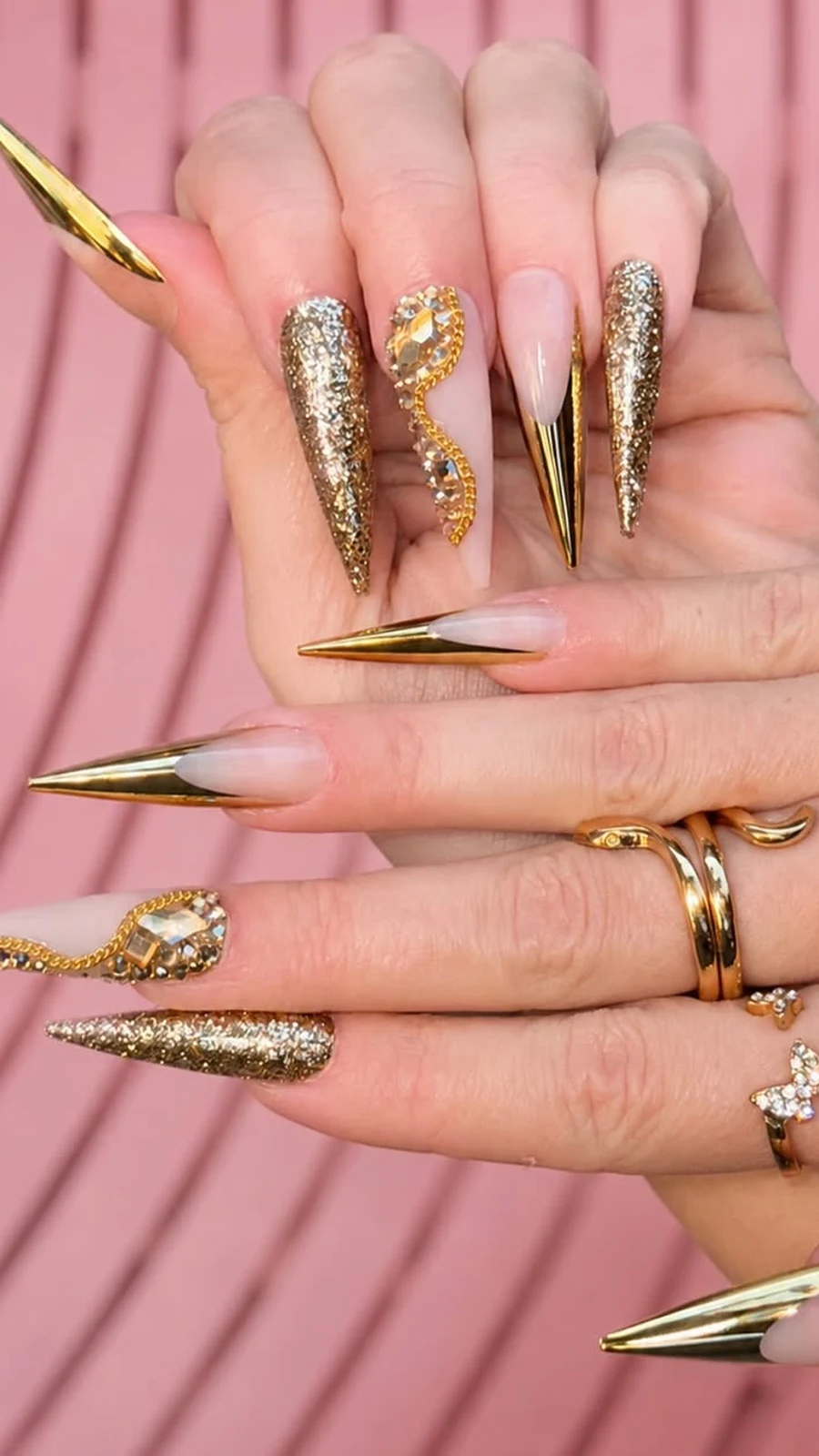
Gold Is the Jewellery Your Nails Have Been Waiting For
There is a particular kind of confidence that comes from gold on your nails, and it has very little to do with money. A thin line of gold along a French tip, a flake of gold leaf floating on a sheer nude base, a single chrome nail catching the light when you reach for your coffee — these are small things, and they change the whole feeling of a manicure. Gold does what good jewellery does: it makes everything around it look more considered, including you.
The reason gold works so reliably is that it is not really one colour. It is a family. There is bright yellow gold, the kind that looks like a new ring. There is champagne gold, soft and almost beige, which behaves like a neutral. There is rose gold, warm and pinkish, which flatters nearly every skin tone. There is antique gold, dulled and burnished, which looks expensive precisely because it is not trying to shine. And there is gold glitter, which is its own mood entirely. Most people who say gold is not for them have simply met the wrong gold — the shade matters as much as the design.
This collection is organised the way you would actually build a gold wardrobe. The first five looks are quiet gold: the kind you can wear to the office, to a parent-teacher meeting, to a Tuesday. The next five are the classics, rewritten — French tips, half-moons and deco lines, but with the proportions changed so they feel new. Then come five pairings, gold with a colour, because gold rarely works alone and the colour you put beside it decides the whole mood. And the last four are full drama, for the days when subtle is not the assignment. Nineteen looks, one metal, and not a single one of them needs a special occasion. Gold is the occasion.
Before you choose, one honest note: gold shows everything. A gold foil flake will highlight a ridge the way a nude polish hides it, and a chrome finish will show every tiny bump in your nail surface. That is not a reason to avoid gold — it is a reason to spend five extra minutes on prep. Buff gently, use a ridge-filling base coat, and let each layer dry properly. Gold rewards patience the way no other finish does.
A Quick Word on Choosing Your Gold
If you have warm skin — veins that look greenish, gold jewellery that has always suited you — reach for yellow gold and antique gold first. They will look like they belong on you, because they do. If your skin is cool — blueish veins, silver jewellery your usual — champagne gold and rose gold are your friends; they have enough softness not to fight with your undertones. If you are somewhere in between, congratulations: you can wear all of it, and your only real decision is the mood. Bright gold for evenings and celebrations, champagne for workdays, rose gold for everything in between.
The other choice is finish. Foil and leaf give you texture and irregularity, which reads as handmade and artful. Chrome gives you a mirror, which reads as bold and modern. Glitter gives you sparkle, which reads as festive. A thin metallic line gives you precision, which reads as expensive. The nineteen looks below use all four, so notice which finish you keep coming back to as you read — that is your gold.
Part One — Quiet Gold
Gold you can wear anywhere, including the meeting you forgot about.
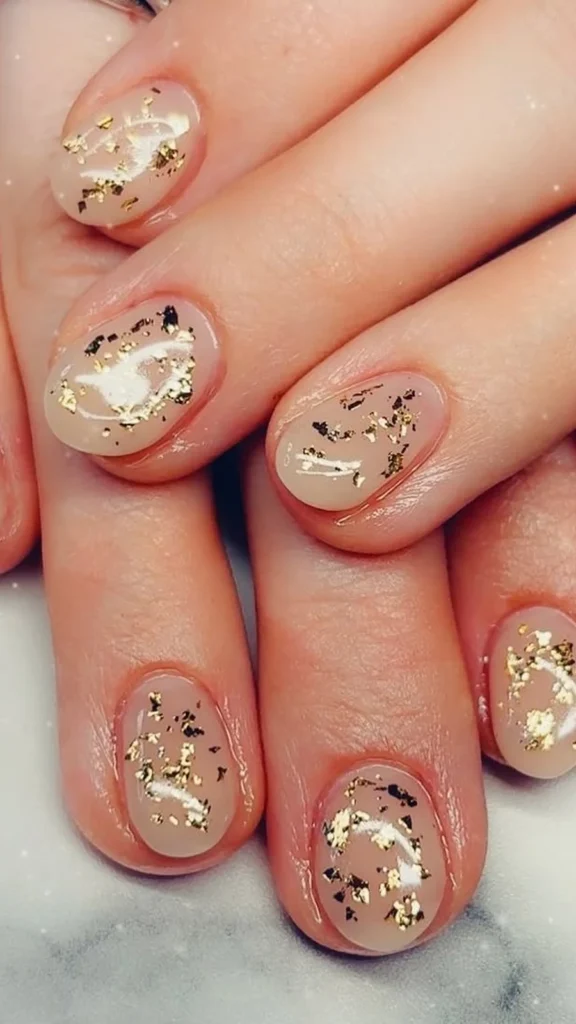
1. Sheer Nude with Floating Gold Leaf
This is the look that converts people who thought gold was too much. A sheer nude base — barely there, just enough to even out the nail — with two or three tiny flakes of gold leaf placed like they drifted down and landed where they pleased. Nothing is symmetrical. Nothing matches. One nail might have a flake near the tip, another near the cuticle, and one nail might have none at all, which is exactly the point. It looks like gold decided to visit, not move in.
The trick is restraint, and the trick to restraint is placing the flakes while the top coat is still wet, then sealing them under a second coat so the edges disappear. If a flake sticks up at the edge, it will catch on everything you touch for a week, so press each one flat with the tip of an orangewood stick and check the edges before you seal. The base should be sheer, not opaque — a milky nude or a translucent blush — because the gold needs the nail showing through underneath it to look light. On an opaque nude, the same flakes look heavier and more deliberate, which is a different look entirely, and a fine one, but not this one.
Additional Information: Gold leaf comes in sheets and in jars of loose flakes; the loose flakes are easier for this look because you can pick up a single piece with a damp brush. Ask your technician for “gold leaf, scattered, sheer base” and show them a photo — the placement is everything. This look lasts well because there is so little on the nail to chip, and when it does grow out, the flakes near the cuticle simply drift further from the edge, which still looks intentional. It suits short nails beautifully, especially rounded ones, and it is the gold look most likely to get you asked where you had your nails done.
2. Gold Cuff Nails
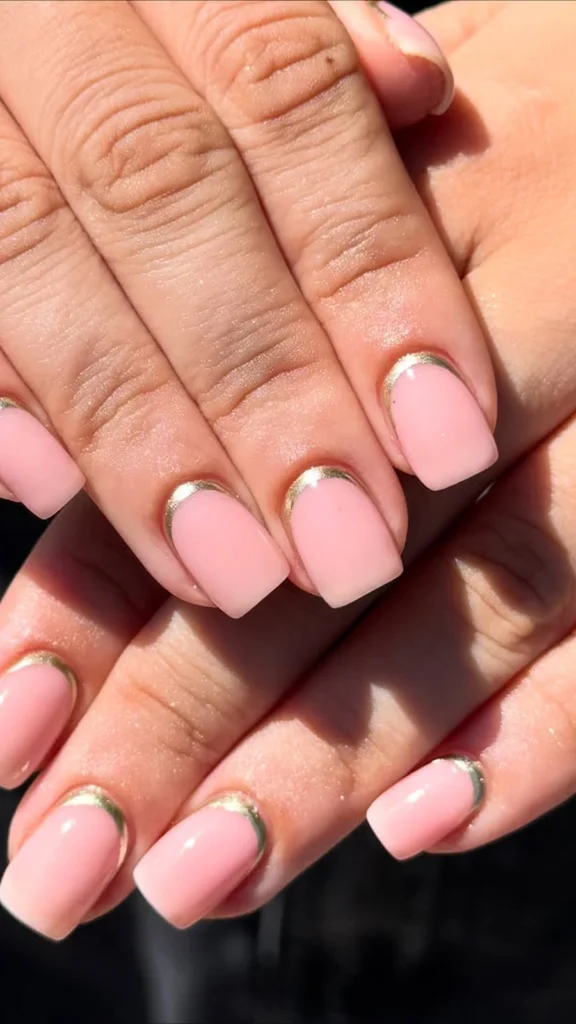
Think of a bangle, but for your nails. A band of metallic gold sits right at the base of each nail, hugging the cuticle line like a cuff, while the rest of the nail stays bare or sheer. It is jewellery logic applied to a manicure: the gold is not the whole outfit, it is the accessory, and because it sits at the base, it moves with your hand in a way that catches the light every time you gesture.
The cuff can be a clean painted band, about two millimetres wide, or it can be a strip of gold foil pressed along the cuticle, or even a thin line of gold beads if you want texture. The clean painted version is the most wearable and the easiest to maintain; the foil version is the most striking, because foil has a slightly uneven, molten quality that paint cannot copy. Either way, the rest of the nail should stay quiet — a sheer pink or a clear gloss — because the cuff is doing all the talking, and a busy base would shout over it. This is also one of the kindest gold looks for short nails, because the band sits at the base and does not need length to make its point.
Additional Information: Cuff nails grow out gracefully, which is their secret advantage: as the nail grows, the band simply moves away from the cuticle, and it still looks deliberate for a full two weeks. If you do them yourself, paint the gold band with a thin striping brush and clean the edges with a flat brush dipped in acetone before the polish sets. A gold chrome powder buffed over a painted band gives the most mirror-like finish; ordinary metallic polish gives a softer, more brushed look. Both are lovely — chrome for evenings, brushed metallic for days.
3. Honey-Gold Ombré
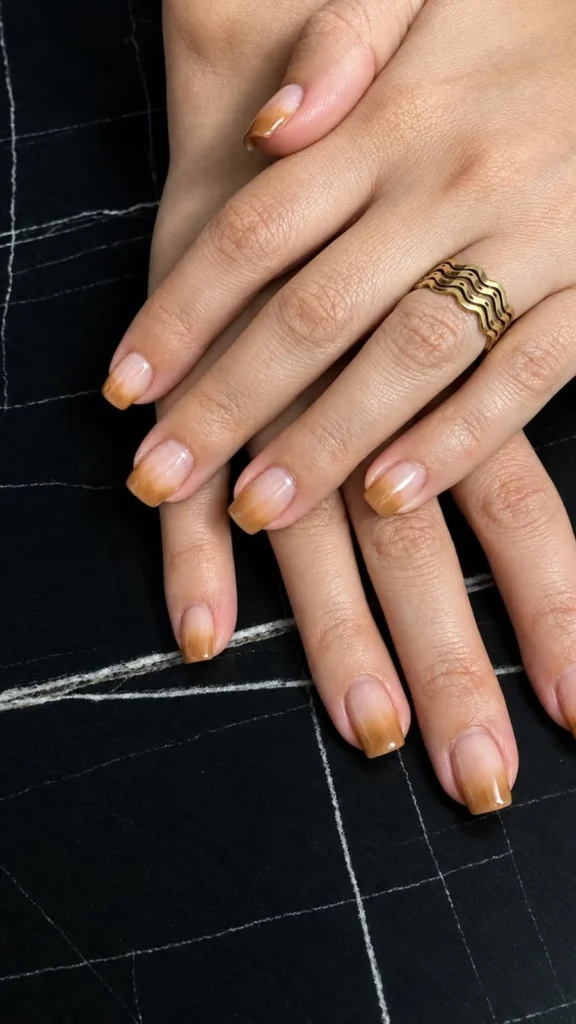
An ombré is a gradient, and a honey-gold ombré is the warmest gradient there is: a soft amber at the base melting into a pale, almost-white gold at the tip, like honey held up to the light. It is not glitter, and it is not chrome — it is colour, shading from warm to light, and it makes the nail look longer than it is, because the eye follows the fade to the tip.
The best version of this uses three shades, not two: a warm honey amber at the cuticle, a true gold in the middle, and a pale champagne at the very tip. Sponged on in thin layers, the transitions disappear and the nail looks like it is glowing from the inside. A single layer of fine gold shimmer over the top — not glitter, just shimmer — ties the three shades together and gives the whole thing a lit-from-within quality. This is a look that photographs beautifully and, more importantly, looks even better in person, because the shimmer moves as your hand moves.
Additional Information: Ombré is one of the few designs that is genuinely easier at a salon than at home, because sponging takes practice and the gradient needs to be seamless. If you try it yourself, use a makeup sponge, dab the three shades onto it in stripes, and press — do not drag — onto the nail, repeating two or three times for depth. Clean up around the cuticle with a small brush before the top coat. Honey-gold ombré suits medium and long nails best, where the gradient has room to travel, and it pairs with gold rings so naturally that you will wonder why you ever wore it with silver.
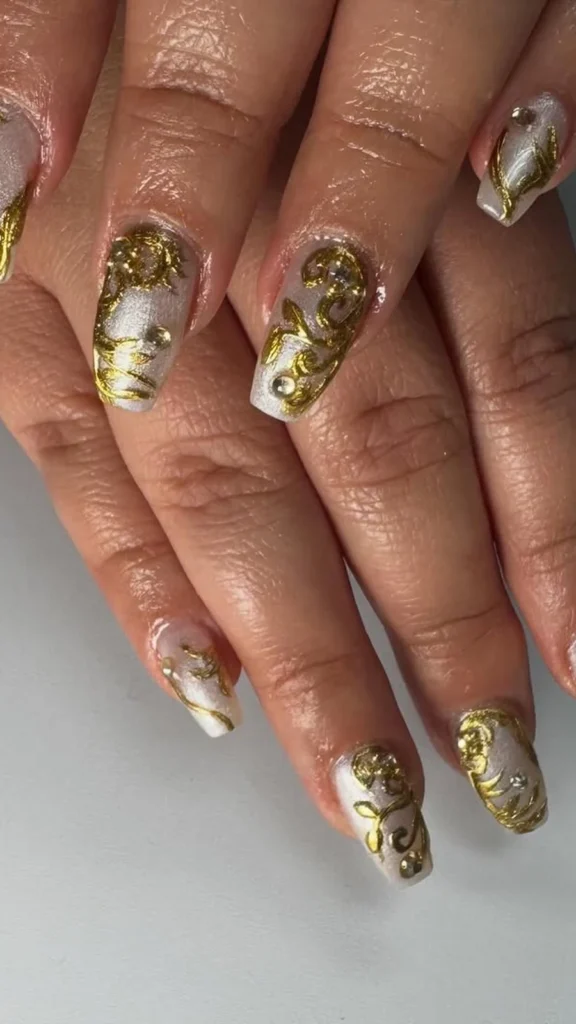
4. Antique Gold Filigree on Ivory
Filigree is the fine, lacy metalwork you see on old jewellery, and on nails it becomes the most romantic gold there is. An ivory or warm cream base, and over it, thin curling lines of antique gold — not bright and mirror-shiny, but dulled and burnished, like gold that has been worn and loved for years. The lines loop and curl, sometimes forming a tiny flower, sometimes just wandering across the nail like a vine.
This look works because of the contrast between the soft ivory and the muted gold. Bright gold on white can look harsh, almost clinical; antique gold on ivory looks warm, like candlelight. The design should stay on one or two accent nails — the ring fingers, usually — with the rest of the nails in plain ivory, because filigree needs empty space around it to be read as delicate. Too much of it, and the lace becomes a tangle. A matte top coat over the ivory with a glossy finish just on the gold lines is a beautiful extra, if your technician can do it, because it makes the gold look raised even when it is flat.
Additional Information: Filigree is almost always hand-painted, so this is a look to book with a nail artist rather than attempt freehand at home, unless you are patient with a very fine liner brush. Stickers and stamping plates exist for filigree patterns and are a good compromise — look for “antique gold filigree” water decals, which sit flat and seal well under top coat. Ivory bases can stain slightly over two weeks, so a good base coat matters, and this design suits oval and almond shapes best, where the curves of the nail echo the curves of the filigree.
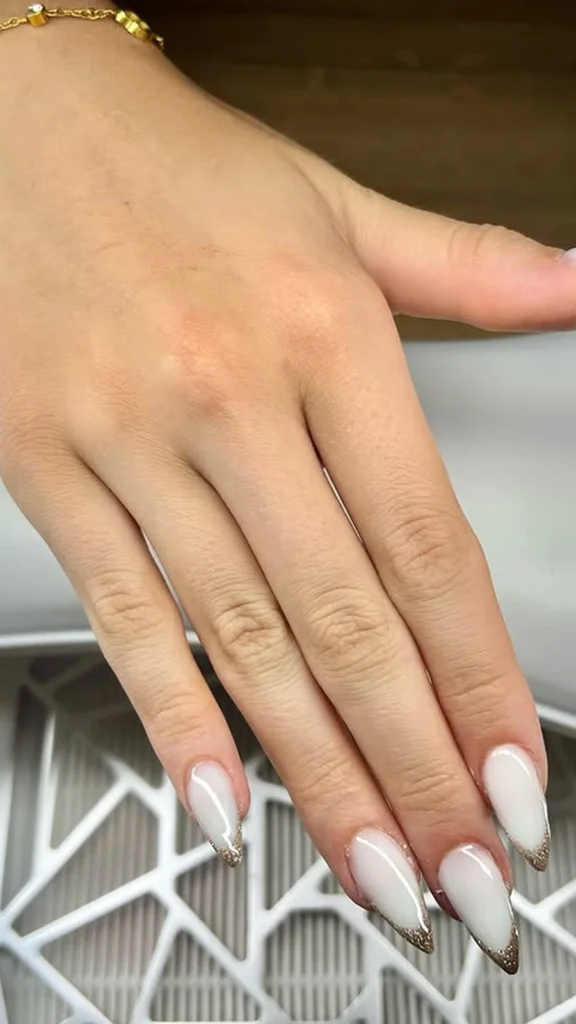
5. Gold Dust on Milky White
If gold leaf is a statement and chrome is a shout, gold dust is a whisper. A milky white base — the kind that looks like a glass of milk with a drop of polish in it — with a fine dusting of gold micro-glitter pressed into the surface, heaviest near the tips and fading toward the cuticle, like gold dust settling. In some lights it looks almost plain white. In others, it glitters quietly, and you catch it when your hand moves.
The key is the size of the glitter. This only works with micro-fine gold dust, the kind that reads as shimmer rather than sparkle. Larger glitter turns it into a party nail, which is also lovely, but it is not this look. The dust should be applied over a wet layer of milky white, pressed in gently with a silicone tool or a fingertip, then sealed under two coats of glossy top coat so the surface feels completely smooth. If you can feel the glitter, you need another coat. Done right, the nail looks like white marble with gold running through it — quiet, expensive, and almost impossible to photograph properly, which is part of its charm.
Additional Information: Milky white bases usually need three thin coats to look even, because the pigment is thin and streaks easily. A ridge-filling base coat helps enormously. Gold dust is forgiving to wear — it hides small chips and regrowth better than any other gold finish — and it suits every nail length, though it is especially pretty on short nails, where the dust has less far to travel. If you want it slightly dressier, add one solid gold accent nail on each hand; the dust and the solid gold play beautifully together.
Part Two — The Classics, Rewritten
French tips, half-moons and deco lines — with the proportions changed.
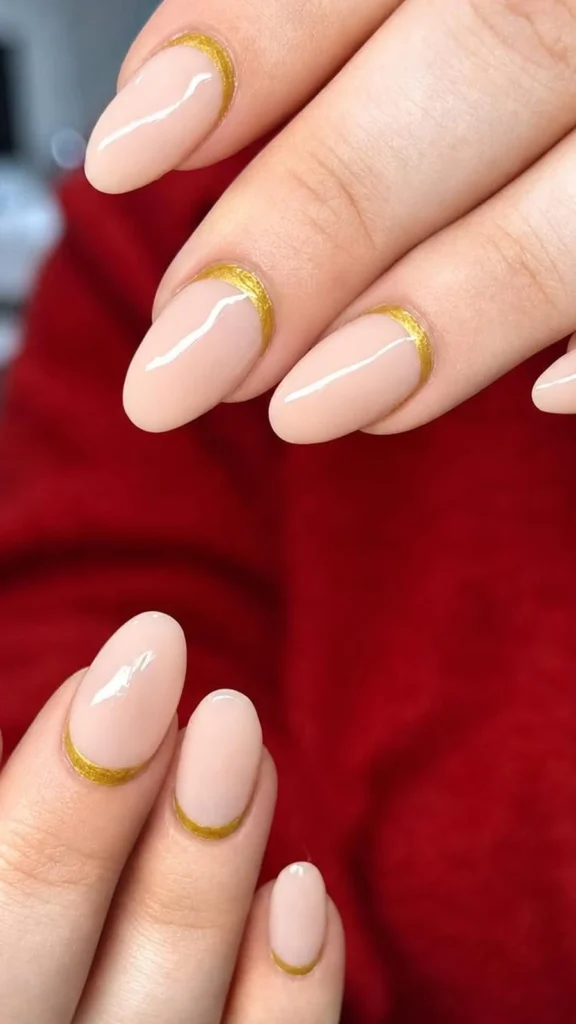
6. The Thin Gold Line French
The classic French manicure is white tips on a pink base. This version keeps the idea and changes exactly one thing: the white tip becomes a single, hairline-thin line of gold, drawn just at the very edge of the nail, with the rest of the nail left sheer. It is the French for people who find the classic French too much — or too little. One line, perfectly placed, and the whole nail looks finished.
Precision is everything here, and it is the kind of precision that is hard to do on yourself with your non-dominant hand, so this is a salon look for most people, or a look for the patient. The line should be thin — a millimetre, no more — and it should follow the smile line of the nail, curving gently. A thick line turns it into a gold tip, which is a different, louder look. The base should be sheer pink or clear, never opaque, because the point is the contrast between almost-nothing and exactly-one-line. On short nails this looks especially chic, because the line sits close to the fingertip and reads as jewellery, not polish.
Additional Information: A gold chrome powder, buffed over a thin painted line, gives the sharpest result; metallic polish alone can look slightly soft at the edges. Ask for “micro French, gold line” and bring a photo, because “French” means ten different things to ten different technicians. This look chips at the tip first, like all French manicures, so a strong top coat wrapped over the free edge helps it last. It is the gold look most likely to be worn by someone who says they never wear nail art — and then gets compliments all week.
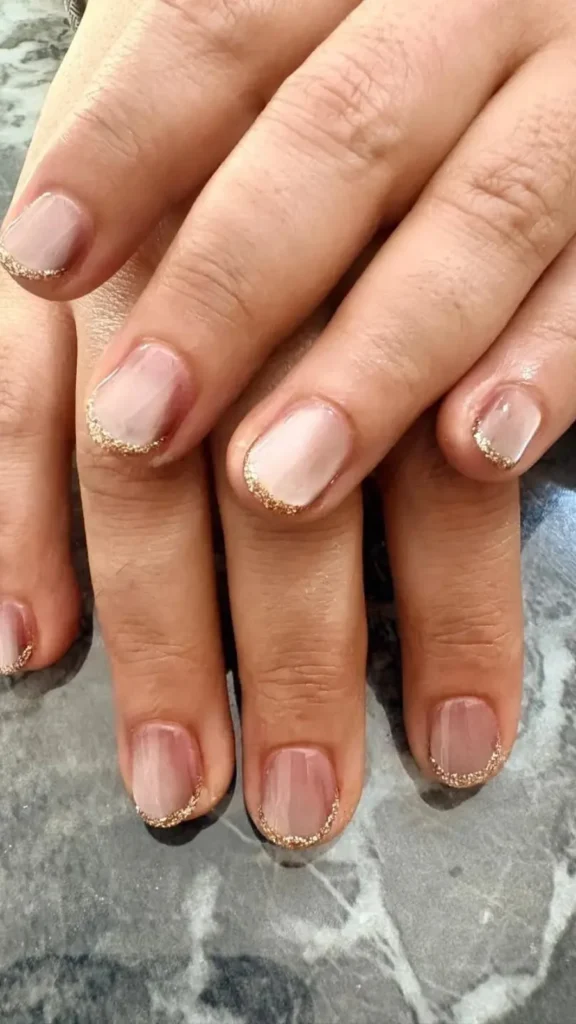
7. Liquid Gold Half-Moons
Half-moons are the oldest trick in the nail book: a crescent of colour at the base of the nail, leaving the rest bare or sheer. In liquid gold, they become something else entirely — a pool of molten metal sitting at the cuticle, catching the light every time you move your hand. The rest of the nail is sheer nude, so the gold crescent looks like it was poured, not painted.
The crescent should be neat and symmetrical, which means either a steady hand or a stencil. Most good technicians use a small round brush and clean up with acetone; at home, reinforcement rings — the little paper circles from stationery shops — make perfect stencils, and they cost almost nothing. The gold should be a true metallic, not a glitter, because glitter in a half-moon looks textured and busy, while a smooth metallic looks like liquid. One coat of a good metallic polish, or a chrome powder buffed over a painted crescent, gives the poured-metal effect. Seal it well, because the edge of the crescent is the first place to lift.
Additional Information: Half-moons are one of the most forgiving designs for regrowth, because the crescent sits at the cuticle and grows out looking like it was always meant to drift. They suit short and medium nails best — on very long nails the crescent can look small and lost, so scale it up slightly. If you love the look but want it softer, try champagne gold instead of yellow gold; the crescent becomes a glow rather than a statement. This is also a lovely design for a wedding guest, a job interview, or any day you want to feel quietly polished.
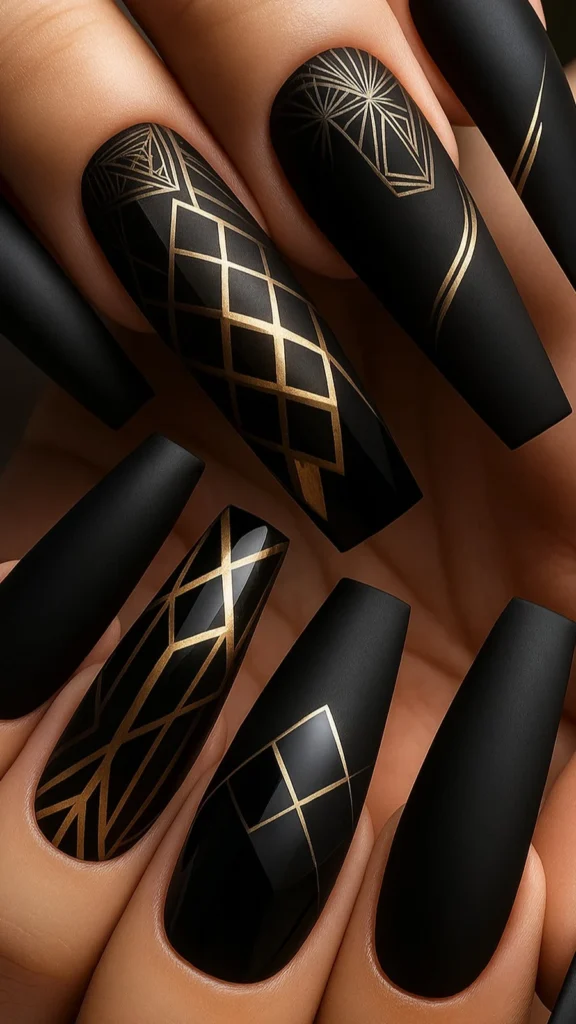
8. Black and Gold Art Deco
If quiet gold is a whisper, black and gold deco is a sentence spoken clearly. A deep, glossy black base — not matte, glossy, because the shine is what makes the gold pop — with thin geometric gold lines: chevrons, fans, sunbursts, the shapes of the 1920s. It is the most architectural look in this collection, and the most dramatic that still counts as wearable, because the geometry keeps it ordered and the black keeps it grounded.
The trick is restraint in the geometry. One motif per nail, drawn with a striping brush or a fine liner, and the motifs should vary — a fan on one nail, a chevron on the next, a single sunburst on the ring finger — so the hand reads as a set, not a repeating pattern. Gold on black needs to be bright and clean, so chrome powder or a high-quality metallic polish, not glitter, and the lines need to be sharp, which means a steady hand and a good brush. A single gold stud at the base of the accent nail is the only extra this design needs; more than that, and the geometry starts competing with the jewellery.
Additional Information: Black polish stains, so a base coat is not optional — two coats of base, ideally, and expect the removal to take a little longer. Black also shows every imperfection in the nail surface, so buff gently and use a ridge filler first. This look suits medium and long nails, where the geometry has room to breathe, and square or coffin shapes, which echo the straight lines of the deco pattern. It is a night-out look, a party look, a New Year’s Eve look — and it is also, unexpectedly, a wonderful look with a plain black dress, because then the nails become the accessory.
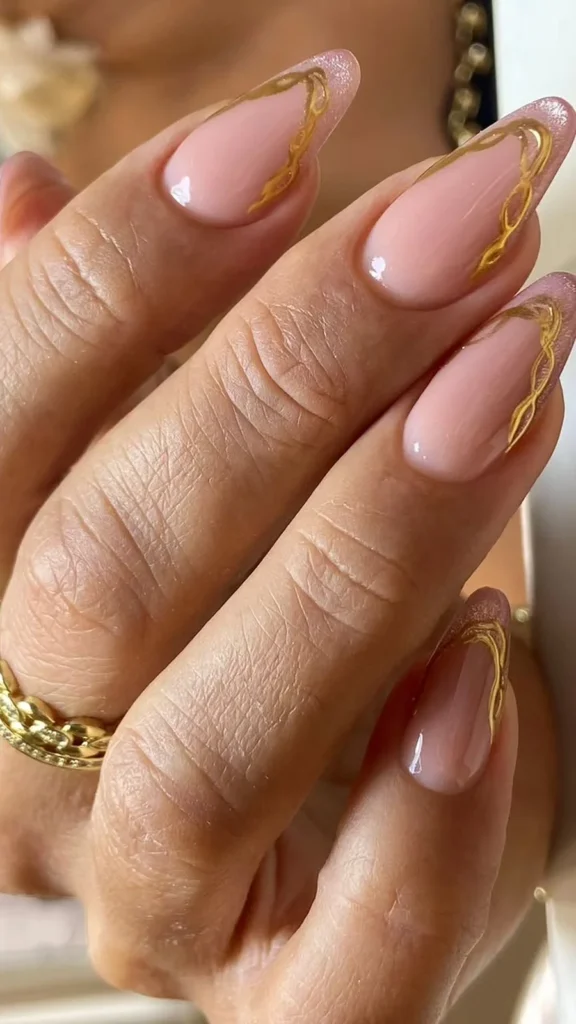
9. Gold Chain-Link Accent
A chain is just a series of small loops, and on a nail, a chain becomes the most interesting accent you can wear. One or two nails per hand carry a fine gold chain-link pattern — tiny interlocking ovals, hand-painted or stamped, running diagonally across a nude or blush base — while the rest of the nails stay plain in the same base colour. It reads as jewellery, literally: the nail looks like it is wearing a bracelet.
The chain can be painted in metallic gold polish with a fine brush, which gives a soft, hand-drawn feel, or it can be done with a stamping plate, which gives cleaner, more regular links. There is also a third option, for the bold: actual tiny gold chain, cut to length and set into gel on the accent nail, which is a real piece of jewellery on your nail and looks extraordinary — and which you should only attempt with a technician who has done it before, because the chain has to be sealed completely or it will catch on everything. Whichever method you choose, the base should be sheer or soft, because the chain needs a quiet background to be read as a chain and not as a tangle.
Additional Information: Chain-link accents are a conversation starter, which is worth knowing before you choose them — people will ask about your nails. The painted and stamped versions last as long as any other nail art; the real-chain version needs more care, and you should avoid it if you work with your hands a lot, because a caught chain can lift the whole design. This look suits almond and oval shapes, where the diagonal chain follows the curve of the nail, and it pairs beautifully with an actual gold chain bracelet, which makes the whole hand look considered.
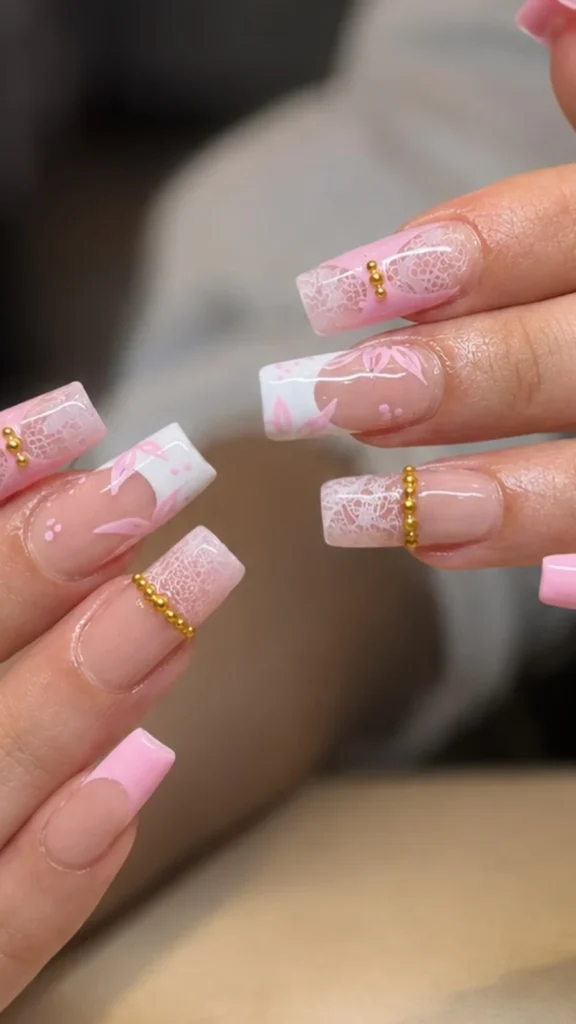
10. Gilded Lace Over Blush
Lace is pattern, and gilded lace is pattern with light in it. A soft blush base, and over it, a fine gold lace pattern — not the chunky lace of a tablecloth, but the delicate, open work of a vintage veil, painted or stamped in thin metallic gold lines, with plenty of blush showing through the gaps. It is feminine without being sweet, and ornate without being heavy, because the blush underneath keeps it soft.
The lace should cover the whole nail on one or two accent nails, and appear only as a small corner or a single motif on the others — a lace edge at the tip, a lace flower near the cuticle — so the hand has a rhythm instead of a uniform. Stamping plates are the practical way to get real lace detail; hand-painting lace freehand is possible but slow, and the pattern needs to be fine to read as lace rather than as scribble. A glossy top coat is important here, because lace in gold needs shine to look like metal rather than like a drawing, and the gloss also protects the fine lines from wearing away at the tips.
Additional Information: Blush is one of the most forgiving bases in the world — it suits every skin tone, it hides chips, and it grows out gracefully — which makes this a very wearable ornate look. If your blush is very pale, use a slightly deeper gold, so the lace does not disappear; if your blush is deep, use a bright gold, so the lace stands out. This design is a natural for weddings, engagements and spring parties, and it looks especially lovely on oval nails, where the soft shape matches the soft pattern. A single pearl or tiny gold bead at the centre of the lace motif on the accent nail is the only extra worth adding.
Part Three — Gold with Colour
Gold rarely works alone. The colour beside it decides the mood.
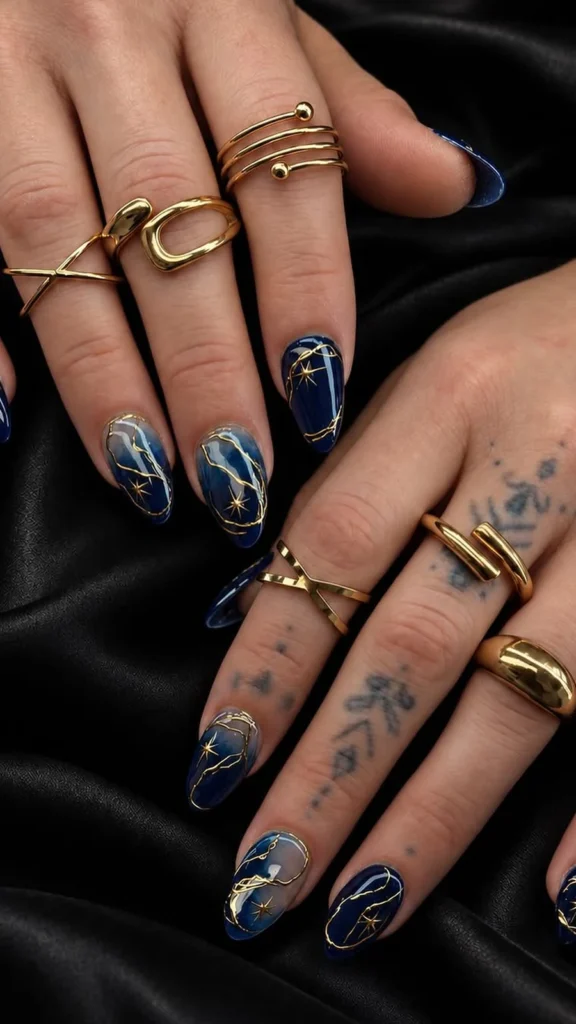
11. Midnight Navy with a Gold Star Map
Navy and gold are the oldest partnership in the book, and for good reason: the deep blue makes the gold look brighter, and the gold keeps the navy from looking flat. This version takes the partnership somewhere specific — a midnight navy base, glossy, with a scattering of tiny gold stars and fine gold lines connecting them, like a constellation map drawn on your nails. Each nail gets a different piece of the sky: one has a cluster of stars, another a single bright star with a trailing line, another just a few dots, so the hand reads as a night sky, not a pattern.
The stars should be small and irregular — some just dots of gold, some four-pointed, some with a tiny tail — because a night sky is not uniform. Gold foil or gold studs work well for the stars, but the most practical method is a fine dotting tool and metallic gold polish, which gives you control over size and placement. The connecting lines should be hairline-thin, barely there, because they are meant to suggest a map, not draw one. And the navy should be deep and glossy, almost black in some lights, because the darker the sky, the brighter the stars.
Additional Information: Deep navy stains the nail plate, so a base coat is essential, and a peel-off base coat is worth considering if you change colours often. The gold stars are easy to repair — a lost star is just a dot of polish away — which makes this one of the most low-maintenance statement looks. It suits medium and long almond nails best, where the sky has room to spread, and it is a wonderful winter look, a New Year’s look, and a look for anyone who has ever wished on a star and meant it. Pair it with silver and it looks cool; pair it with gold jewellery and it looks like evening.
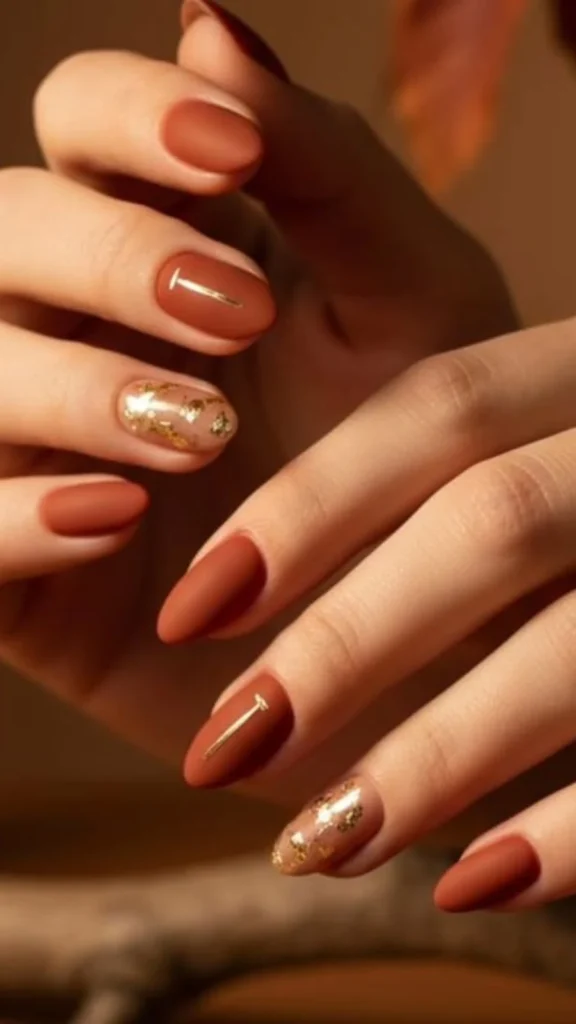
12. Terracotta and Gold Desert
Terracotta is warm earth, and gold is warm light, and together they make the most grounded look in this collection — the colour of clay pots in the sun, of desert sand at golden hour. A warm terracotta base, matte or satin rather than glossy, with gold accents that look like they belong in the landscape: a thin gold line tracing the tip, a scatter of gold foil like sunlight on sand, a single sun motif on the ring finger.
The matte finish matters here, because terracotta with a high gloss can look loud, while terracotta with a matte or satin finish looks earthy and calm, and the gold on top of it looks like it was placed there by the sun. The gold should be warm — yellow gold or antique gold, never bright chrome — because the whole look is about warmth, and a cool, mirror-bright gold would argue with it. One accent nail with a hand-painted gold sun, simple rays, simple circle, is the centrepiece; the other nails just need the foil or the line.
Additional Information: Terracotta suits warm skin tones beautifully and looks striking on deep skin, where the warm orange-brown glows; on very fair skin, choose a softer, more muted terracotta so it does not overwhelm. Matte top coats wear faster than glossy ones, so expect to refresh the top coat after a week if you want the matte finish to last. This is an autumn look, a holiday look, a look for warm weather and warm rooms, and it pairs with brown leather, cream linen and — inevitably — gold jewellery, which will look like it was made for it.
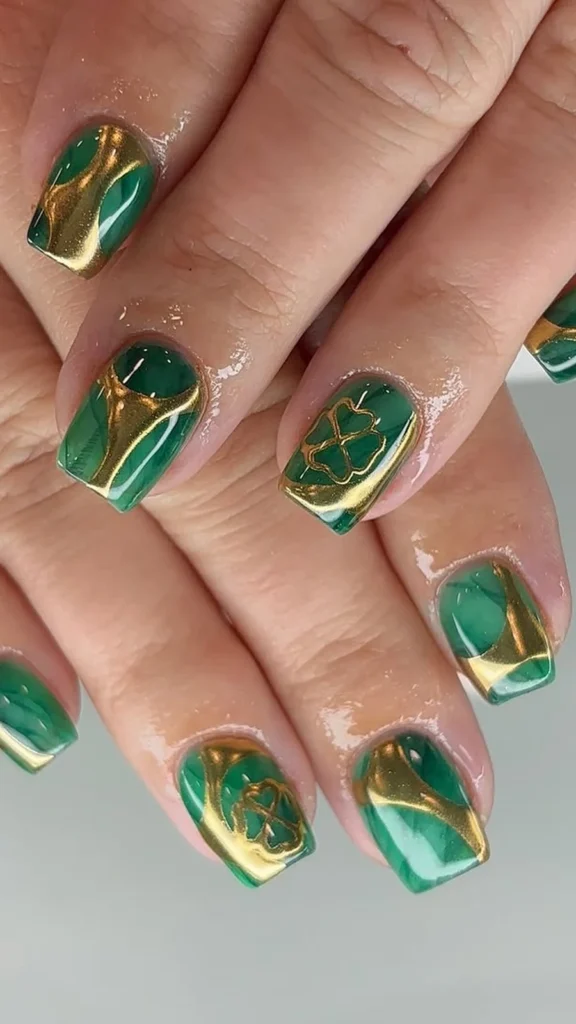
13. Emerald and Gold Vintage
Emerald and gold is the combination of old jewellery boxes and vintage glamour, and on nails it has the same effect: a deep, rich green, glossy, with gold that looks like it was set into it — a gold frame around the cuticle, a gold line down the centre of the accent nail, a scatter of gold leaf that looks like it grew there. It is the most regal look in this collection, and also one of the easiest to wear, because emerald flatters almost everyone and gold is its natural partner.
The green should be deep, not bright — a true emerald, the colour of the stone, not the colour of a traffic light. On the accent nails, the gold can be bolder: a full gold nail on the ring finger, or a gold-framed emerald, where a thin gold border runs around the edge of the nail like a picture frame. That framed nail is the detail that makes the whole set feel designed rather than just coloured, and it is easier than it looks — a striping brush and a steady hand, or a thin gold striping tape, which gives a perfectly straight line. Keep the rest of the nails plain emerald, because the green is doing enough work on its own.
Additional Information: Deep green, like deep navy and black, can stain, so a base coat is essential. Emerald looks wonderful on short nails, where the deep colour makes the nail look neat and finished, and it is a natural for the festive season, for winter parties, and for anyone who likes their manicure to look like a piece of jewellery. If emerald feels too dark for you, try it as an accent — two emerald nails and the rest gold, or emerald tips on a nude base with a gold line between them — and you will get the richness without the commitment.
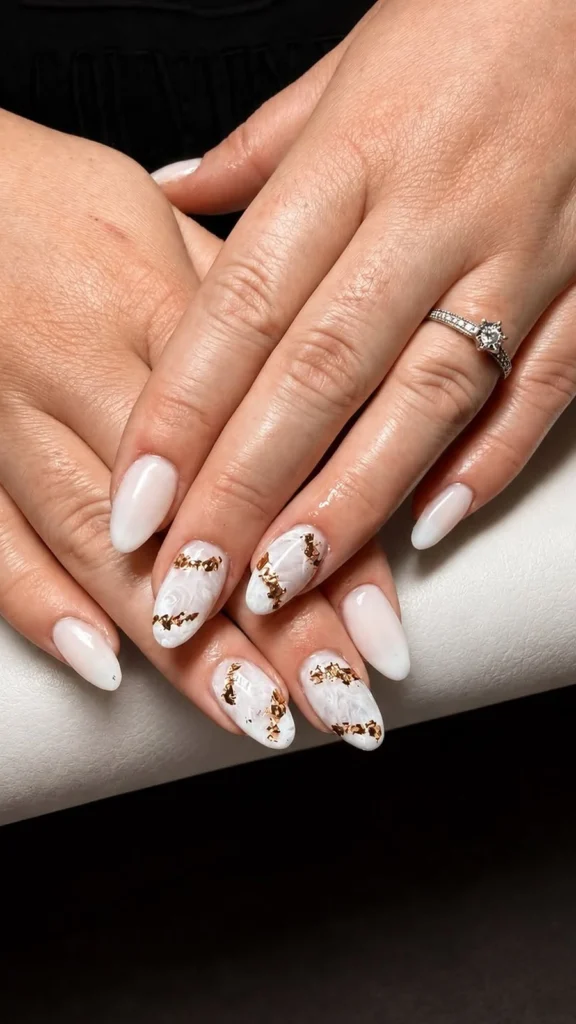
14. Rose Gold Marble Swirls
Rose gold is gold with a blush in it, and marble is the pattern that lets it show off. A soft white or pale blush marble base, with veins of rose gold running through it — not grey, not black, but rose gold, so the marble looks warm instead of cold. Each nail gets a different swirl, because real marble never repeats itself, and the veins should be thin and wandering, not thick and regular.
Marble is done with a water technique or with a fine brush dragging the rose gold through a wet white base, and both methods need the base to be wet when the gold goes in, so the colours bleed into each other slightly. That bleed is the point: it is what makes the marble look like stone instead of like a drawing of stone. A glossy top coat is essential, because marble without gloss looks like paper, and marble with gloss looks like a polished stone countertop. One nail in solid rose gold chrome, on each hand, anchors the set and gives the eye somewhere to rest.
Additional Information: Marble looks are different every time, which is both their charm and their challenge — if you want two hands to match, book a technician who does marble often, because the technique is in the wrist. At home, the “drag a toothpick through wet polish” method works surprisingly well for a first attempt. Rose gold suits cool and neutral skin tones especially well, and this design is a natural for spring, for weddings, and for anyone who wants their nails to look like they belong in a beautiful bathroom. It suits medium nails best, where the swirls have room to wander.
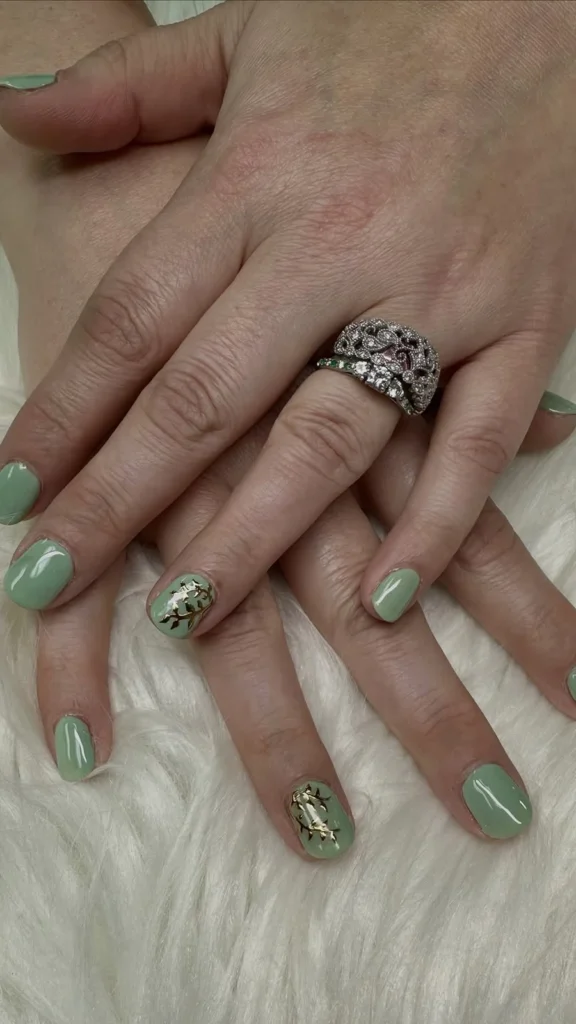
15. Gold and Sage Botanical
Sage is the quiet green of the moment, and gold is what wakes it up. A soft sage base — muted, greyish-green, the colour of a leaf in shade — with fine gold botanical linework: a single stem running up the accent nail, a tiny leaf here, a small bud there, drawn in thin metallic gold. The rest of the nails stay plain sage, because the plant needs space to be read as a plant.
The linework should be delicate and sparse. One stem, two or three leaves, and that is the whole drawing — a botanical illustration, not a garden. Gold on sage is a gentle combination, and it works because the two colours are close in temperature: both warm, both muted, neither shouting. A matte top coat over the sage with a glossy finish on just the gold lines is a lovely touch, if your technician offers it, because it makes the gold look like it is catching the light while the sage stays soft. This is the most peaceful look in the collection, and the one most likely to be worn by someone who loves plants and means it.
Additional Information: Sage is a forgiving colour — it hides chips, it suits most skin tones, and it grows out gracefully — which makes this a very practical pretty look. The botanical linework is best done with a fine liner brush and metallic gold polish; stamping plates with leaf designs are a good alternative if freehand feels daunting. This design suits short and medium nails, and it is a natural for spring and summer, for garden parties, and for anyone whose favourite colour has always been green. Pair it with gold rings and a cream sweater, and the whole outfit comes together.
Part Four — Full Drama
For the days when subtle is not the assignment.
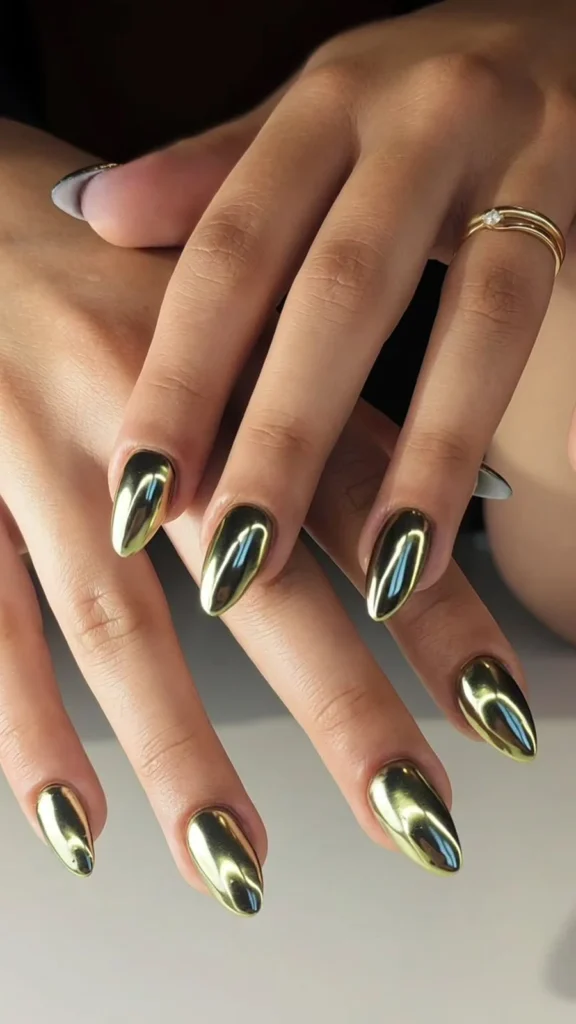
16. Champagne Gold Chrome Mirror
Chrome is gold at its most confident: a mirror finish, so reflective you can almost see yourself in it. Champagne chrome is the wearable version — softer than yellow gold chrome, warmer than silver, the colour of the inside of a champagne glass held up to the light. Worn on all ten nails, it is a statement. Worn on two accent nails with a nude base on the rest, it is a statement with manners.
Chrome needs a perfectly smooth nail underneath, because a mirror shows everything, and that means prep is not optional: buff gently, use a ridge-filling base, and apply the chrome powder over a black or dark base coat if you want depth, or over a nude base if you want softness. The powder is buffed on with a silicone applicator, sealed with a top coat that does not dull it — and that last part matters, because the wrong top coat turns a mirror into frosted glass. Ask your technician which top coat they use for chrome, and if they hesitate, find one who does chrome often.
Additional Information: Chrome chips at the tips faster than ordinary polish, so a top coat wrapped over the free edge helps, and gel chrome lasts much longer than regular-polish chrome — if you love this look, get it in gel. Champagne chrome suits every skin tone, because it is neither too yellow nor too pink, and it is the gold finish most likely to make you stare at your own hands in the lift. It is a party look, a holiday look, a look for the days you want to feel like the best-dressed person in the room, and it pairs with absolutely everything, because champagne goes with everything.
17. Gold Beaded Cuticle Line
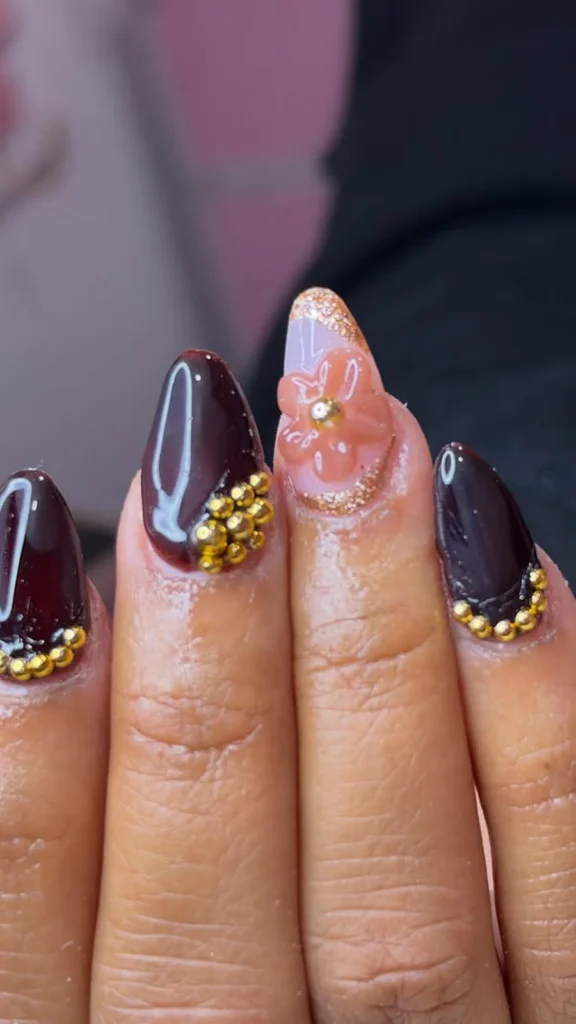
Beads are the most tactile gold there is. A row of tiny gold beads — micro-beads, the size of a pinhead, or slightly larger caviar beads — set in a neat line along the cuticle of each nail, like a string of pearls, but gold. The rest of the nail is a deep, glossy colour: burgundy, or navy, or a rich chocolate, something dark enough to make the beads glow against it.
The beads are set into wet gel or into a thick layer of top coat, one by one, with a wax pencil or a damp brush, and then sealed under another coat so they sit flush and do not catch on fabric. The line should follow the curve of the cuticle exactly, which takes patience, and the beads should be evenly spaced, which takes a steady hand — so this is a salon look, and a look to book with someone who has done beadwork before. The effect is extraordinary: the nails look like they are wearing a necklace, and the beads catch the light with every movement of your hand.
Additional Information: Beaded nails need care — avoid picking at the beads, and be gentle with the cuticle area for the first day while the seal sets fully. They last well in gel, less well in regular polish, so gel is the sensible choice. This look suits medium and long nails, where the bead line has room to curve, and it is a natural for formal occasions, for brides, for anyone who wants their nails to be the jewellery. If a bead comes off, a single dot of nail glue and a replacement bead will fix it in a minute, so keep a few spare beads in your kit.
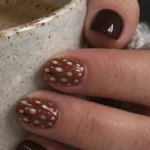
18. Burnished Gold Foil on Chocolate
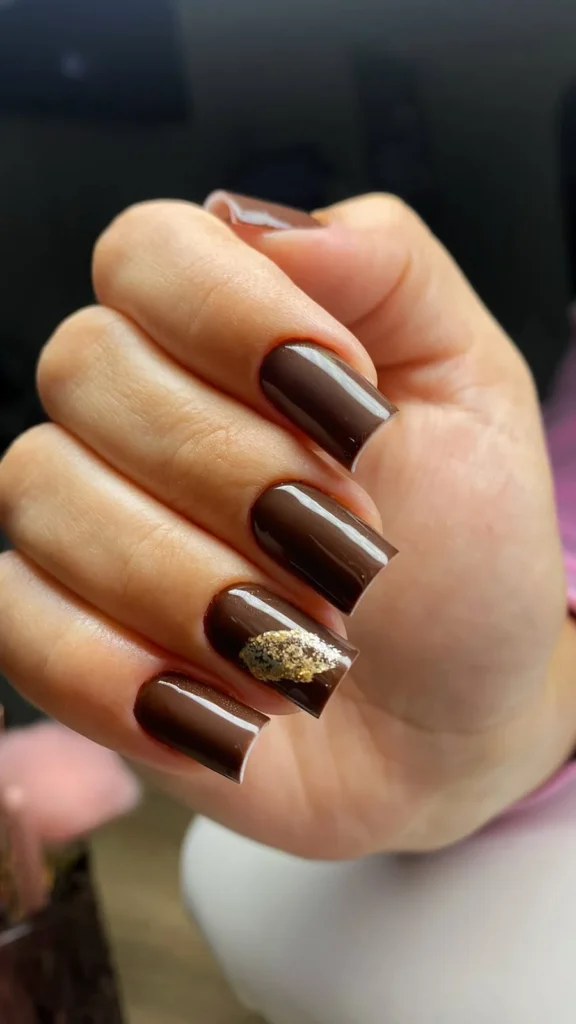
Chocolate brown is the most underrated nail colour there is — rich, warm, flattering on every skin tone — and burnished gold foil is its perfect partner. A deep chocolate base, glossy, with large, irregular pieces of gold foil pressed onto the surface, burnished flat so they look like gold leaf that has been there for years, not like something stuck on yesterday. The foil should be uneven, overlapping, catching the light differently on every nail, because that irregularity is what makes it look like real gold leaf on an old frame.
The technique is simple and forgiving: paint the chocolate base, let it dry until it is just tacky, press the foil on with a silicone tool, and seal it under two coats of top coat. The foil will tear and fold as you press it, and those tears are the point — they are what make it look burnished rather than printed. One nail in solid gold foil, or solid gold chrome, anchors the set and gives the eye a place to rest. The rest of the nails just need the foil scattered where it pleases, heavier near the tips, lighter near the cuticle, like gold dust settling on chocolate.
Additional Information: Chocolate brown is wonderfully forgiving — it hides chips, it suits every skin tone, and it is one of the few dark colours that does not stain badly. Gold foil is equally forgiving: it hides imperfections in the base, it does not need to be symmetrical, and if a piece lifts, another piece pressed on top will fix it. This is an autumn look, a winter look, a look for cosy rooms and warm drinks, and it pairs with brown leather, cream knits and gold jewellery so naturally that you will wonder why you ever wore chocolate nails without gold.
19. Golden Hour Gradient
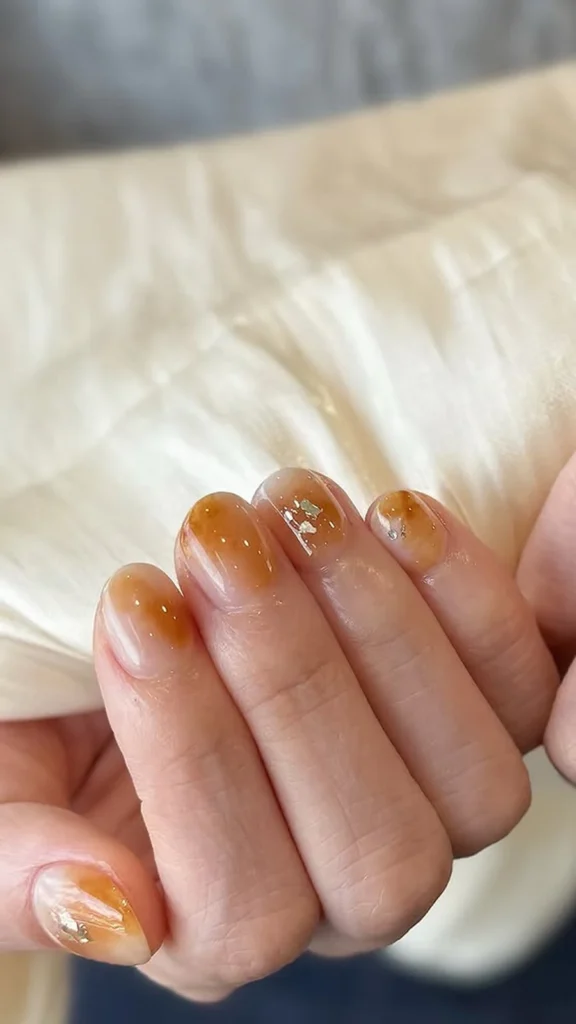
The last look is the one the whole collection has been building toward: the golden hour, on your nails. A gradient that runs from a warm amber at the cuticle, through true gold in the middle, to a pale, glowing champagne at the tip — but with a difference from the honey ombré earlier in this collection. This one is done in chrome and shimmer, not in flat colour, so the gradient does not just change colour, it changes light: the base glows warm, the middle shines, and the tip sparkles, like the sun going down over a field.
The gradient is sponged on in layers, then a fine gold shimmer is dusted over the whole nail, and a glossy top coat seals it into something that looks lit from within. In daylight it is warm and golden; in evening light it is luminous, and the shimmer moves as your hand moves, which is the whole point of a golden-hour look — it is not a colour, it is a time of day, and it changes as the light changes. This is the look to choose when you want your nails to be the prettiest thing in the room, and you do not mind if people notice.
Additional Information: Golden-hour gradients need a good base coat and patience, because the sponge layers must be thin and dry between coats, or the gradient turns muddy. Gel gives the smoothest result, but regular polish works if you are patient. This look suits long nails best, where the gradient has room to travel from amber to champagne, and it is a natural for summer evenings, for holidays, for golden light and warm rooms. It is also, fittingly, the look to wear with your favourite gold jewellery — the nails and the rings will reflect each other all evening.
How to Make Gold Last
Gold is beautiful, and gold is also honest about how you treat it. Foil lifts if you pick at it. Chrome dulls if you scrub without gloves. Glitter snags if the top coat is too thin. A few habits will keep any of these nineteen looks beautiful for two full weeks: wear gloves for washing up, because hot water and detergent are the enemy of every manicure and gold most of all. Reapply a thin layer of top coat every three days — it takes two minutes, and it is the single most effective thing you can do. Do not use your nails as tools, to open cans or scrape labels, because gold finishes show the damage first. And oil your cuticles daily, because healthy cuticles make the gold look intentional instead of accidental.
If a design does start to wear, gold is unusually forgiving to repair. A lost flake can be replaced with a new flake. A chipped chrome tip can be touched up with metallic polish and a fresh top coat. A worn gold line can be redrawn in a minute. Keep a bottle of your gold polish at home, even if the original manicure was done in a salon, and you will never have to live with a damaged design for more than a day.
Which Gold Is Yours?
If you have read this far and still cannot choose, here is the short version. If you want one gold look to try first, try the sheer nude with floating gold leaf — it suits everyone, it suits every occasion, and it will tell you whether you are a gold person. If you want the most compliments, try the champagne chrome or the black and gold deco — they are the two looks people actually stop and ask about. If you want the easiest to live with, try the gold dust on milky white or the gold cuff — both grow out gracefully and hide wear. And if you want the one that feels most like you, trust the finish you kept noticing as you read: foil people are romantics, chrome people are bold, glitter people are celebrators, and thin-line people are minimalists who like their luxury quiet. All four are right. Gold has room for all of them.
FAQ
Does gold nail polish suit every skin tone?
Yes — the shade of gold matters more than the gold itself. Yellow gold flatters warm skin, champagne and rose gold flatter cool skin, and antique gold suits almost everyone. If one shade looks wrong on you, try another before deciding gold is not for you.
Is gold foil hard to remove?
No. Gold leaf and foil come off with ordinary nail polish remover, just like any other polish. The flakes may need a few extra seconds of soaking, but they do not damage the nail. Soak a cotton pad, hold it on the nail for ten seconds, and wipe — do not scrape.
Can I wear gold nails to the office?
Absolutely, if you choose the right look. Quiet gold — floating gold leaf, a gold cuff, gold dust on milky white, the thin gold line French — reads as polished and professional. Save the full chrome and the black and gold deco for evenings and weekends.
How long do gold nail designs last?
About two weeks in gel, and seven to ten days in regular polish, with a top-coat refresh every three days. Foil and leaf designs often last longest, because there is less polish to chip; chrome wears fastest at the tips.
What jewellery should I wear with gold nails?
Gold, naturally — but the shade should roughly match. Yellow gold nails with yellow gold rings, rose gold with rose gold, champagne with either. Mixed metals can work if it is deliberate, but matching is the easy, elegant choice.
Is gold leaf safe for natural nails?
Yes. Gold leaf sits on top of the nail under top coat and does not interact with the nail plate at all. It is one of the gentlest forms of nail art, and it comes off cleanly with remover.
A Last Word
Gold has been worn on nails for thousands of years, and it has never once gone out of style, because it is not really a trend. It is a material — warm, bright, alive in a way that no other colour is — and every generation finds a new way to wear it. These nineteen looks are the current ways: quiet and loud, classic and new, foil and chrome and glitter and a single thin line. The right one is the one that makes you look at your hands and smile, not the one that photographs best on someone else. Try one. Wear it for two weeks. And when someone asks where you had your nails done, tell them the truth: you chose gold, and gold did the rest.
Leave a Reply